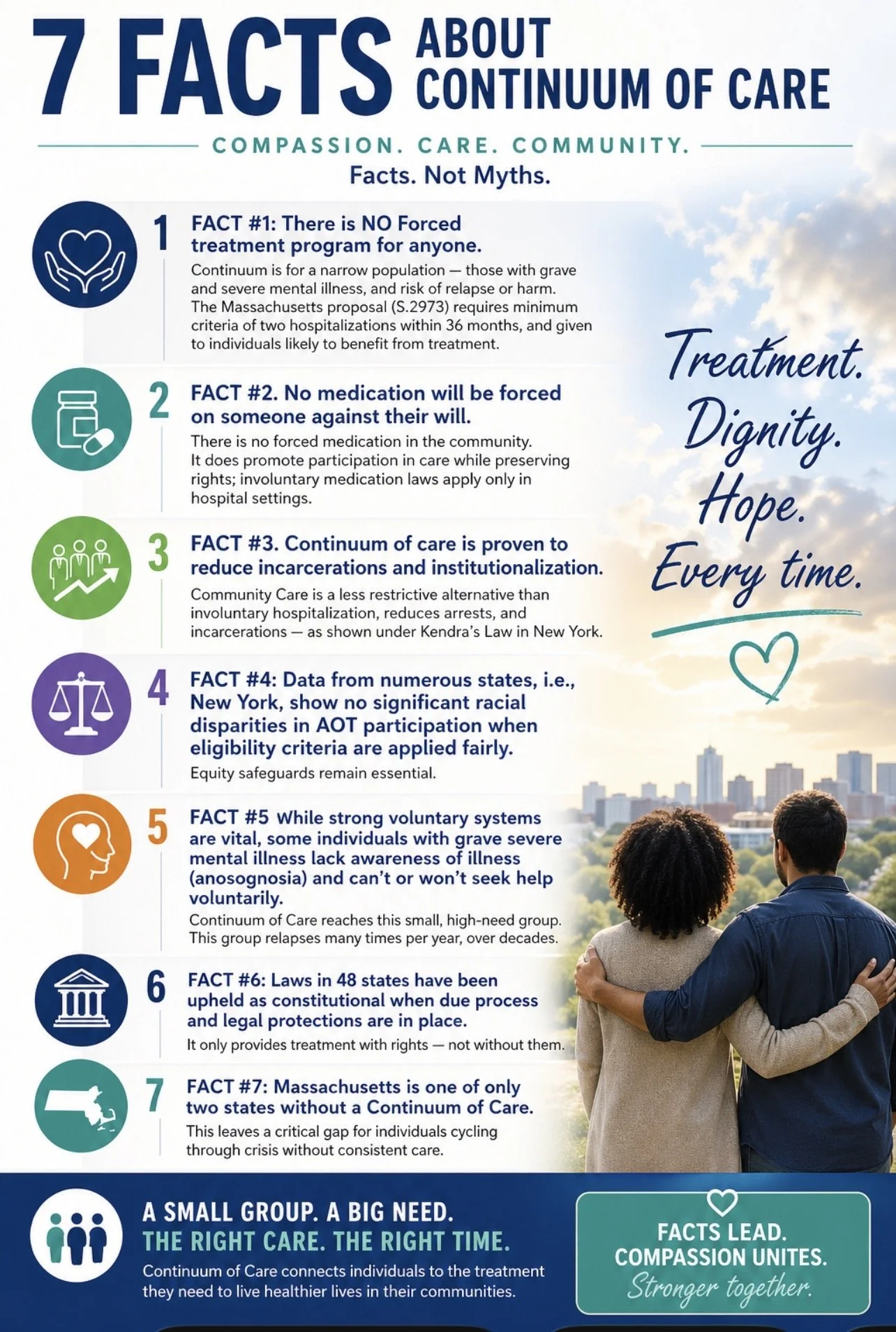
Fact #1: There is NO Forced treatment program for anyone.
Continuum is for a narrow population — those with grave and severe mental illness, and risk of relapse or harm. The Massachusetts proposal (S.2973) requires minimum criteria of two hospitalizations within 36 months, and given to individuals likely to benefit from treatment.
Fact #2. No medication will be forced on someone against their will.
There is no forced medication in the community. It does promote participation in care while preserving rights; involuntary medication laws apply only in hospital settings.
Fact #3. Continuum of care is proven to reduce incarcerations and institutionalization.
Community Care is a less restrictive alternative than involuntary hospitalization, reduces arrests, and incarcerations — as shown under Kendra’s Law in New York.
Fact #4:. Data from numerous states, i.e., New York, show no significant racial disparities in AOT participation when eligibility criteria are applied fairly.
Equity safeguards remain essential.
Fact #5 While strong voluntary systems are vital, some individuals with grave severe mental illness lack awareness of illness (anosognosia) and can’t or won’t seek help voluntarily.
Continuum of Care reaches this small, high-need group. This group relapses many times per year, over decades.
Fact #6: Laws in 48 states have been upheld as constitutional when due process and legal protections are in place.
It only provides treatment with rights — not without them.
Fact #7: Massachusetts is one of only two states without a Continuum of Care.
This leaves a critical gap for individuals cycling through crisis without consistent care.